
Faculty Origin
Hits: 3899
Faculty of Applied Arts (1839 – 2025)
◆ The origins of the Faculty of Applied Arts, as a scientific institute in the modern era, trace back to the School of Arts and Royal Industries, established by Mohamed Ali Pasha in 1839 in Bulaq under the name School of Operations. At that time, it specialized in training practical engineers and skilled technicians.
Later, it became known as the School of Arts and Royal Industries when Mohamed Ali Pasha recognized the urgent need to prepare practical engineers and trained technicians to meet the country's demand for establishing factories, preparing commercial ships and naval fleets, and constructing essential facilities for Egypt’s development.
Throughout its long history, the school underwent numerous modifications and reforms to keep pace with evolving societal needs. By the 1908-1909 academic year, the School of Arts and Royal Industries comprised three departments:
- Mechanical and Electrical Engineering
- Building and Urban Planning
- Decorative Arts and Industries
In 1910, a Cabinet decree established new regulations confirming this system, setting a five-year study period, including four academic years and a final year for practical training. The third department (Decorative Arts and Industries) was divided into three specialized divisions:
- First Division: Textile, Dyeing, and Carpet Weaving
- Second Division: Engraving, Carving, and Carpentry
- Third Division: Decorative Metalwork
The first group of students from this department graduated in 1913. By the 1918-1919 academic year, the Decorative Arts and Industries Department became independent, forming a separate school. The Englishman William Stewart, then Deputy of the Royal School of Arts and Industries, was appointed as its director.
The new school was located in Fadel Pasha Al-Dramalli’s Palace in Hamzawy, Cairo, and was named the Egyptian School of Arts and Ornamentation. It maintained the same three divisions, now converted into independent academic departments. The study duration remained five years, with the final year dedicated to industrial training and practical application in factories and production units. Graduates were awarded a diploma in one of the three specialized fields.
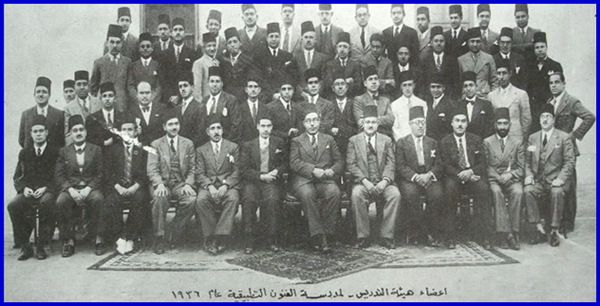
◆ In 1928, William Stewart left, and his compatriot John Edney took over as director. He relocated the school to its current site at the Orman Palace in Giza and renamed it the School of Applied Arts. Edney introduced curriculum reforms, including the establishment of a Preliminary Section that accepted students with a primary school certificate. This section had a three-year study program, culminating in a diploma in one of ten industrial specializations, according to the following structure:
- Woodworking, Engraving, and Antiques
- Textile Weaving and Dyeing
- Textile Printing
- Stained Glass with Lead
- Engraving and Ornamentation
- Ceramics
- Decorative and Industrial Metalwork
- Decorative Ironwork
- Photography
- Watchmaking
Note: The watchmaking specialization was later transferred to the Mechanical Industries School due to the difference in its technical nature.
◆ In 1933, some specializations were merged, and a new Higher Section (Third Section) was introduced. Admission to this section was restricted to graduates of the Preliminary Section and outstanding students from three-year industrial schools. After three years of study, students were awarded a diploma. The first class graduated in 1935, and the last class under this system graduated in 1944.
This section included eight specializations:
- Furniture (Woodworking) and Wood Engraving
- Textile Printing, Carpets, and Kilims
- Glass and Ornamentation
- Silverwork and Decorative Metalwork
- Ironwork and Decorative Enamel
- Textile Weaving and Dyeing
- Ceramics
- Photography
◆ In 1934, Mohamed Bek Hassan El-Sherbini became the first Egyptian director of the school. He led efforts to Egyptianize its administration and faculty, replacing the many foreign professors and artists who had previously taught at the institute, coming from England, France, Italy, Russia, and Germany.

Helwan University strives to be a leading educational and research institution in technology and the arts, and excels in education and sciences according to international quality standards
- Visits 120218